

A character that guests have passed for nearly six decades is doing something new. Disney has installed its first projection-mapped face on an Audio-Animatronic figure inside one of its theme parks, and the debut happens in a classic scene at Disneyland. The skeleton pirate sitting atop the pile of gold in Pirates of the Caribbean now acts out a story he could never tell before. Here is a closer look at what changed and how the technology works.
The First In-Park Use of Next-Generation Animatronics
The pirate in scene 11 of Pirates of the Caribbean is the same figure who has watched over his gold for 59 years, frozen in place as a skeleton. He now moves and emotes through a hybrid system that combines a traditional animatronic body with a real-time projected face.
This marks the first time Disney has used the next-generation Audio-Animatronic technology inside a park. Imagineering teased the approach back in November 2025, describing front-projection faces that could add expression and emotion to figures. The Pirates installation answers the question many fans had after that reveal, which was where the technology would show up first. Rather than launching in a brand-new land, it arrived in one of the oldest scenes Disney has.
The Story the Pirate Can Finally Tell
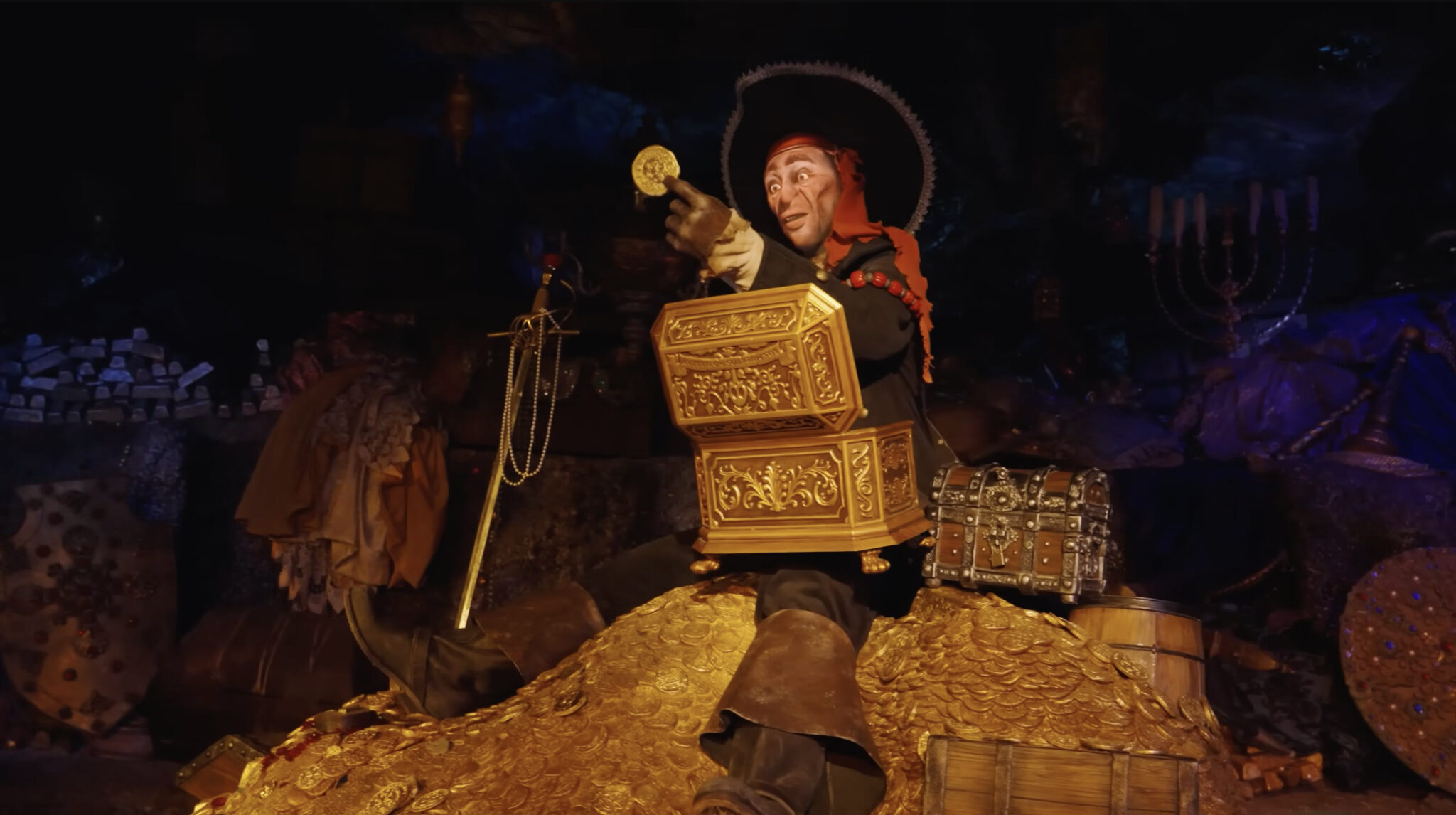
With the new face in place, the figure plays out a looping story that explains how he ended up where he is. The pirate finds a single cursed gold coin, and the moment he picks it up, the spell freezes him. Later, his arm drops the coin and the curse lifts, but his greed pulls him right back to grab it again.
The cycle then repeats. Imagineering describes three distinct moods that carry the character through the loop, giving guests a piece of the backstory that was always implied but never shown. It turns a static figure into a small narrative that plays out on its own.
How the Projection System Works

The system layers two technologies on top of each other. A traditional animatronic handles the physical movement, while that figure’s animation data feeds in real time into Unreal Engine, a product of Disney’s partnership with Epic Games. The projected face reacts to whatever the figure does, so the image and the motion stay in sync.
The challenge is the surface. Disney is projecting onto a moving figure rather than a flat screen, which makes alignment far more difficult. The team developed and patented a technique to keep the image locked in place. In a walkthrough video, an Imagineer slides the projected face off the figure to prove it really is a projection, then moves the figure by hand while the image follows it precisely.
Hidden Markers and Built-In Backups

Calibration is one of the more clever parts of the project. A camera system in the scene needs visible targets to locate an object, but the heavily costumed pirate did not lend itself to obvious markers. Imagineering solved this by building the calibration markers directly into the pirate’s bandanna.
Those markers stay invisible to guests during the day. They activate under UV light, so the system calibrates at night when the markers glow yellow, and the UV lights switch off once the park opens. The scene also uses two projectors, with only one running at a time and the second held in reserve as a backup. Disney built redundancy into the tracking as well, so even if a motor fails and the figure moves incorrectly, the projected face stays aligned with it.
What This Could Mean Going Forward
When Imagineering first revealed the technology, it pointed to characters that could benefit from projected faces, including figures with exaggerated features or strong emotional range. That raised questions about where the system might appear in future projects.
For now, the Pirates figure serves as a working proof of the concept in a live attraction. Seeing it run inside a long-standing scene rather than a test lab suggests the technology is ready for real guest viewing. Whether it expands to other characters and attractions remains to be seen, but the foundation is clearly in place.
Conclusion
The updated pirate in Pirates of the Caribbean shows how Disney is blending physical animatronics with real-time projection to add new life to its figures. From the hidden bandanna markers to the patented alignment method and the built-in backups, the project reflects a careful approach to a tricky technical problem. As the first in-park use of this technology, it offers an early look at where Audio-Animatronics may be headed next.

Written by
Rachel Van Norman
Contributing Writer
Rachel fell deeply in love with all things Disney as a little girl. Now as a wife and a mother herself, she shares this Disney obsession with her son and everyone around her. From her love of princesses to eating all the Disney food, Rachel spends her time radiating Disney magic and keeping everyone up to date on Disney news.


